


.svg)


The secret to hacking is context.
TL;DR: Attackers exploit the gaps between what you think your API surface is and what it actually is. Shadow and obsolete APIs, partial or stale Swagger specs, missing authentication/role semantics, and the absence of stateful flows make most scanners blind or noisy. The first step in any real API security program is discovering and understanding what to test—then you can add realistic identities, sequences, and data to find high-impact issues. Pynt was built to do exactly that: discover everything from traffic and infra, infer semantics, and run stateful scenario tests that reproduce real attacks.
APIs are not just endpoints and JSON. They are code paths, business logic, state machines, identity boundaries, and organizational assumptions stitched together across teams, environments, and deployment waves. The hardest vulnerabilities - broken auth, BOLA, chained business-logic bypasses, and timing/race issues - only appear when you exercise the right combination of identity, state, and sequence. That “right” combination is context, and context is rarely fully present in a Swagger/OpenAPI file.
The catalog problem: shadow, partial, and obsolete APIs
Many organizations treat OpenAPI as the canonical inventory of their API surface. In practice, the spec is often:
- Missing entirely for internal or service-to-service endpoints (shadow APIs). These endpoints live in code, in service meshes, or are discovered only in runtime traffic. Attackers and ops people find them - scanners that rely on specs do not.
- Partial or stale. Teams ship small endpoints or add query params and forget to update the spec. The result: large blind spots and false confidence.
- Obsolete. Deprecated endpoints linger in runtime (or in older containers, older environments, or behind feature flags). Old code paths can contain unpatched logic that no longer matches security expectations.
- Fragmented across teams. Gateway configs, Kubernetes manifests, test collections, and developer sandboxes each tell part of the story; no single artifact shows everything.
Shadow and obsolete APIs are both symptoms and causes of partial specs: a spec that’s not kept current transforms into a partial spec, and a partial spec makes it trivial for shadow endpoints to survive unnoticed. The security scorecard that shows “100% spec coverage” is therefore meaningless unless you can validate that the spec matches reality.
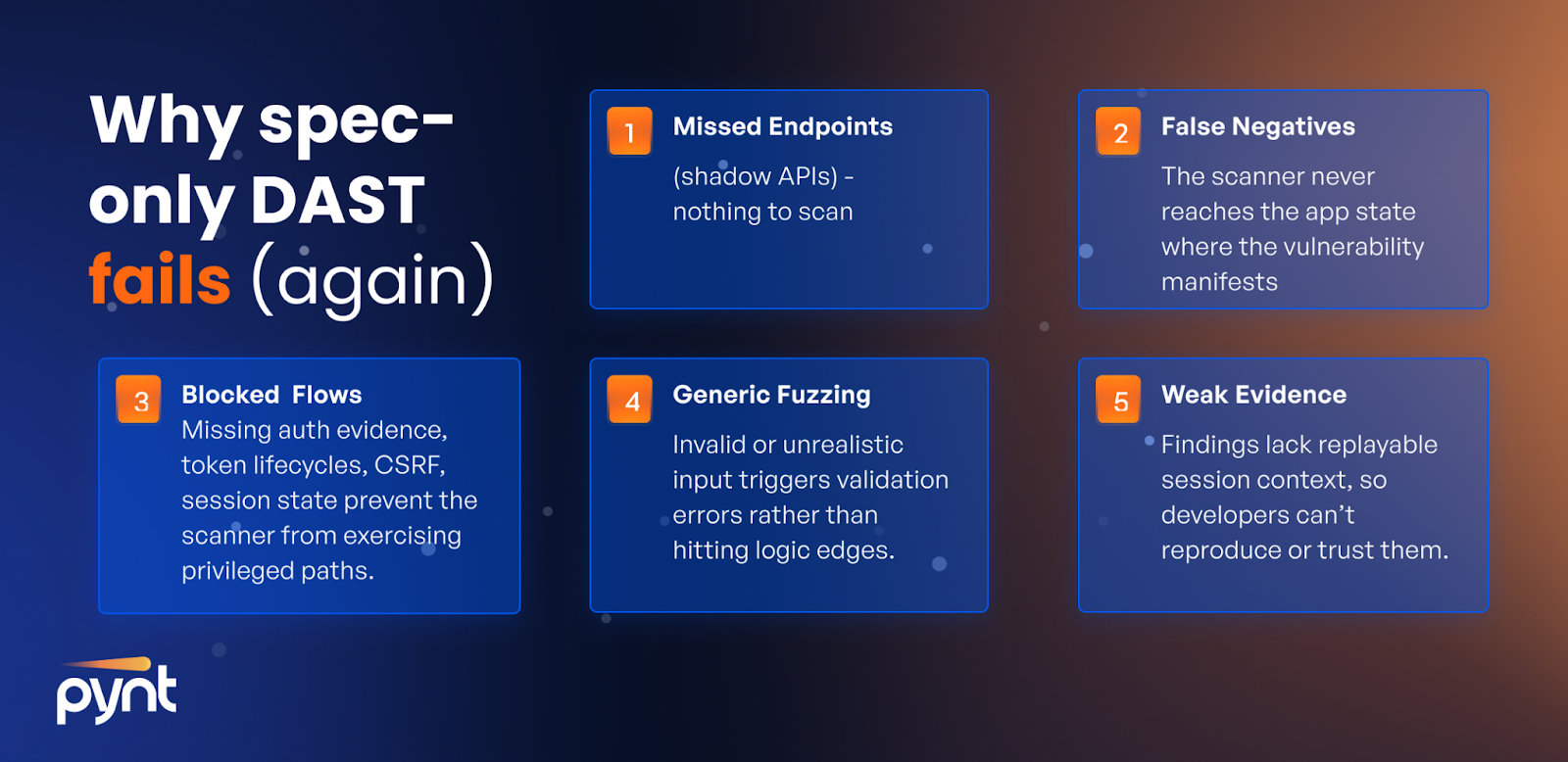
Why spec-only DAST fails (again)
Classic DAST that treats Swagger as the source of truth breaks in predictable ways:
- Missed endpoints (shadow APIs) - nothing to scan.
- Blocked flows - missing auth evidence, token lifecycles, CSRF, and session state prevent the scanner from exercising privileged paths.
- False negatives - the scanner never reaches the app state where the vulnerability manifests (e.g., it can’t perform “create -> escalate -> transfer”).
- Generic fuzzing - invalid or unrealistic input triggers validation errors rather than hitting logic edges.
- Weak evidence - findings lack replayable session context, so developers can’t reproduce or trust them.
In short: spec-driven, stateless scans test the contract surface, not the runtime story.
How to test effectively: context, semantics, and scenarios
To find real, fixable API risks, you need three capabilities:
- Complete discovery. Combine spec, traffic, infra, and test artifacts to build a live API catalog. This surfaces shadow endpoints, obsolete routes, and environment-specific quirks.
- Semantic inference. Convert raw fields into meaningful parameter types (User IDs, tokens, resource IDs...). Understand role/tenant claims, OAuth scopes, and which parameters map to sensitive business objects.
- Stateful scenario execution. Run multi-step flows (preserve cookies, tokens, CSRF, side effects) and mutate specific steps to probe for logic flaws: BOLA, privilege escalation, sequence tampering, race conditions.
How Pynt approaches the problem
Pynt’s engineering choices aim squarely at the gap between spec and reality:
- Traffic & test ingestion: Pynt ingests HARs, Postman collections, CI test traces, and lightweight agents (eBPF) so it sees everything that actually runs - not only what was documented.
- Triangulated discovery: We merge OpenAPI files, gateway configs, and captured traffic into a unified API catalog so shadow and obsolete endpoints surface immediately.
- Automatic semantics: By analyzing request/response pairs and test sequences, Pynt infers parameter roles and builds realistic payload templates (e.g., account IDs, currency semantics, and boolean flags that map to privileges).
- Authentication-aware testing: Pynt recognizes common auth flows and replays flows with role switches and scope changes to exercise authorization boundaries.
- Scenario runner: Instead of firing single, isolated requests, Pynt replays and mutates multi-step scenarios - preserving state, timing, and side effects - to reproduce high-impact business logic attacks.
Actionable evidence: Every finding includes the exact sequence, input values, and a curl script so developers can reproduce and fix quickly.
Why a single solution across the SDLC matters
Security shouldn’t be a disconnected checklist. When discovery and testing live in separate processes, you get gaps: brittle handoffs, duplicated work, and windows of exposure that span CI, staging and production.
Pynt is designed to be a single source of truth across the SDLC:
- Pull runtime and CI artifacts into the same catalog developers and security teams use.
- Run discovery early (in CI and pre-prod) and continuously in runtime to catch drift.
- Use the same scenario runner to validate fixes, preventing regression.
One solution that spans discovery and testing reduces friction, speeds remediation, and ensures you’re testing the same inventory developers deploy.
Context is the attack surface. If you only test what’s in a file, you miss what’s in production. If you only fuzz, you miss the business logic. The secret in hacking is that the exploit almost always lives in how things are used - not just in what’s documented. Build your discovery, infer semantics, then run stateful scenarios. That’s how you catch the hard bugs before attackers do.
Final takeaway
Context is the attack surface. The exploit almost always lives in how your APIs are used — the identities, states and sequences in production - not just in what’s written in a file. Start by discovering what exists, infer the semantics that make parameters meaningful, and then test with stateful, identity-aware scenarios. That’s how you catch the hard bugs before attackers do.
Pynt was built for that reality: discover everything, infer intent, and test the flows that matter. If you treat OpenAPI as the beginning of your security workflow - not the end - you’ll stop testing imaginary APIs and start securing the ones attackers actually target.
Learn more about Pynt's Behavior-Based Discovery and Testing works here.


